Dry Needling for Plantar Fasciitis: Heel Pain Relief in Reno
Stubborn heel pain? Learn how dry needling, StemWave, and hands-on manual therapy relieve plantar fasciitis at a concierge Reno PT clinic.
If your first steps out of bed each morning feel like stepping on a tack (a sharp, stabbing pain under your heel that eases as you walk but comes roaring back after you’ve been sitting) you’re almost certainly dealing with plantar fasciitis. It’s the most common cause of heel pain, and in an active town like Reno, it sidelines runners, hikers, pickleball players, nurses, and anyone who spends the day on their feet.
The frustrating part isn’t just the pain. It’s how stubborn it can be. People try new shoes, drugstore inserts, rolling a frozen water bottle, and weeks of stretching, only to find the heel pain still there months later. If that’s you, there’s a more direct, hands-on path, and it starts with understanding why your foot hurts in the first place.
What plantar fasciitis actually is
The plantar fascia is a thick band of tissue that runs along the bottom of your foot, connecting your heel bone to your toes and supporting the arch. When it’s overloaded, it develops tiny areas of irritation and degeneration near the heel. According to OrthoInfo, the patient-education site from the American Academy of Orthopaedic Surgeons, the classic symptom is:
“Pain with the first few steps after getting out of bed in the morning, or after a long period of rest, such as after a long car ride.”
Here’s a key point most people miss: the heel is where you feel the pain, but the calf and foot muscles above it are often where the problem is driven. Tight, overworked muscles in the calf (gastrocnemius and soleus) and the small muscles of the foot create constant tension on the fascia where it attaches to the heel. Treat only the heel and you keep chasing the symptom. Address the muscles pulling on it, and you finally change the underlying mechanics, which is exactly what dry needling is built to do.
How dry needling helps plantar fasciitis
Dry needling is a technique a trained physical therapist uses to release tight, irritable knots in muscle called trigger points. As the APTA’s patient resource ChoosePT explains:
“Dry needling is a technique physical therapists use (where allowed by state law) to treat pain and movement impairments.”
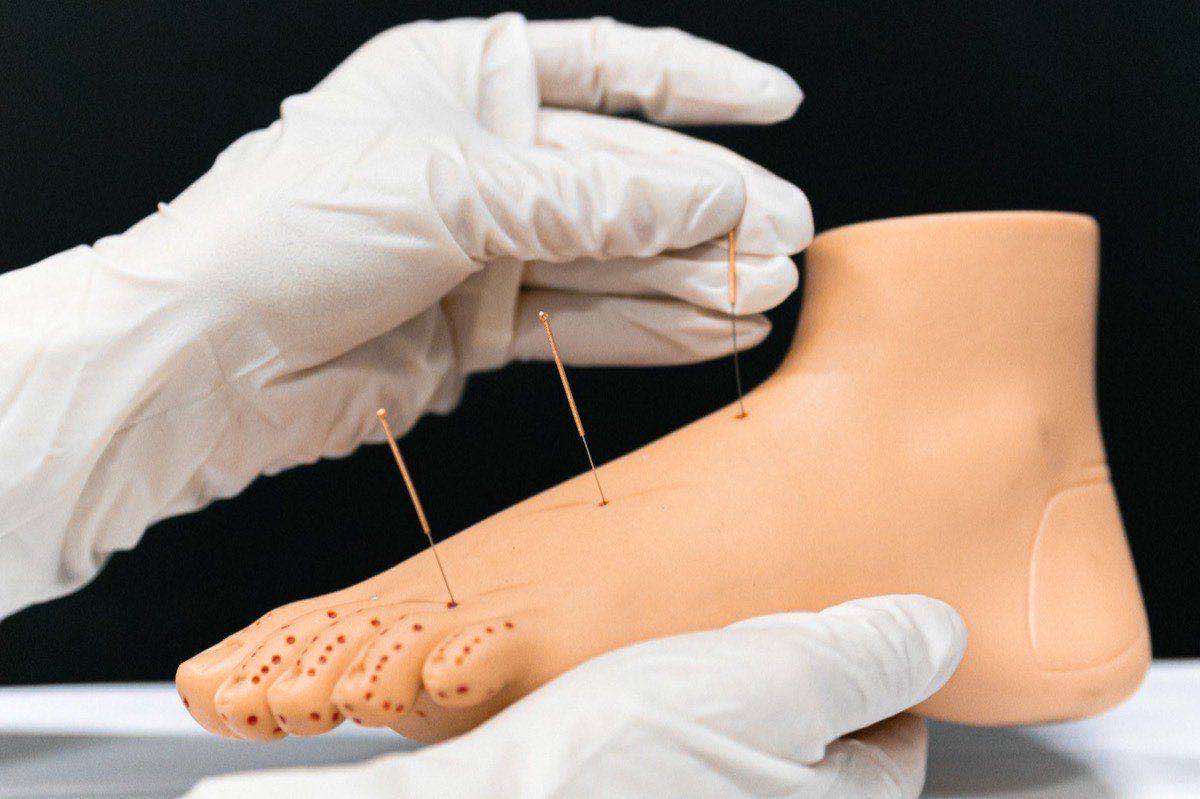
A thin, sterile filiform needle (no medication, no injection) is inserted into the trigger points in the calf, arch, and plantar muscles. ChoosePT notes plainly that “dry needling is not acupuncture”; it’s a modern, evidence-based technique that “can inactivate trigger points to relieve pain or improve range of motion.” When the needle reaches a tight band, it often produces a brief twitch response, then the muscle releases. That release reduces the constant pull on the plantar fascia and turns down the local pain signaling, relief at the source rather than a temporary mask.
The research backs this up. A 2024 systematic review and meta-analysis of 12 randomized controlled trials (781 patients) published in a peer-reviewed journal and indexed on PubMed concluded:
“Dry needling is effective in relieving pain and restoring function in patients with plantar fasciitis. Furthermore, dry needling may take at least 1 month to take effects in patients with plantar fasciitis.”
, Systematic review and meta-analysis, PubMed Central (PMC11688614)
That last sentence matters for setting expectations: dry needling is powerful, but it works best as part of a plan over a few weeks, not a single magic-bullet session. You can learn more about how we use it on our dry needling page.
Where StemWave (shockwave) fits in
For heel pain that has dragged on for months, we often pair dry needling with StemWave: a form of extracorporeal shockwave therapy (ESWT). Where dry needling releases the muscles pulling on the fascia, shockwave targets the degenerated tissue at the heel itself. OrthoInfo describes how ESWT works for plantar fasciitis this way:
“During this procedure, high-energy shockwave impulses stimulate the healing process in damaged plantar fascia tissue.”
In plain terms, StemWave delivers focused acoustic energy into the irritated tissue to jump-start your body’s own repair response and break the cycle of chronic inflammation. It’s noninvasive, requires no incision and no downtime, and it’s often tried before anyone starts talking about injections or surgery. For many stubborn cases, the combination of dry needling (to fix the mechanics) and StemWave (to heal the tissue) does what stretching and inserts alone never could. See our StemWave page for what a session involves.
Manual therapy ties it all together
Needles and shockwave are tools, not the whole treatment. At Healing Hands, every plan is anchored in hands-on manual therapy and bodywork: skilled soft-tissue work and joint mobilization through the calf, ankle, and foot, plus targeted myofascial release where the fascia attaches. This restores the ankle mobility and tissue glide that let you push off and walk normally again, and it’s what protects the gains from needling and shockwave so the pain doesn’t simply creep back.
You’ll also leave with a short, specific set of loading exercises and stretches. These come after hands-on care has given you relief, and they’re tailored to keep your progress, not a generic handout.
What a concierge visit in Reno looks like
This is where Healing Hands is different from a high-volume insurance clinic. Your appointment is a full hour, one-on-one, with Dr. Jamie Pribyl (PT, DPT, MTC): never handed off to an aide or parked on a machine.
A typical heel-pain visit looks like:
- A real evaluation: we examine your foot, ankle, calf, gait, and footwear to find why the fascia is overloaded, not just confirm that it hurts.
- Hands-on treatment that same visit: manual therapy to the calf and foot, dry needling to the driving trigger points, and StemWave to the heel tissue when it’s indicated.
- A clear plan: exactly how many visits we expect, what to do at home, and how to keep training or working while you heal.
Because every session is a focused hour of treatment by the doctor, people typically need far fewer visits than the two-to-three-times-a-week schedule a rushed clinic prescribes. We serve patients throughout the region (see our Reno area page) including Sparks, Carson City, and the Tahoe communities.
A clear cash-pay value
Healing Hands is an out-of-network, cash-pay practice, and for heel pain that’s often an advantage, not a drawback. You get the doctor’s full attention every visit, treatment isn’t dictated by an insurer’s rules about what’s “medically necessary,” and pricing is known up front with no surprise denied-claim bills weeks later. Because visits are fewer and longer, the total cost is frequently competitive with (and sometimes less than) a long string of short copay visits once you add up the time, gas, and lost work. We can also provide a superbill, an itemized receipt you can submit to your insurer for possible out-of-network reimbursement.
If you’ve been limping through your mornings for months, you don’t have to keep waiting it out. Call or text (775) 452-4471 to talk through your heel pain and find out whether dry needling, StemWave, and hands-on care are the right fit for you.
Frequently Asked Questions
Does dry needling hurt? Most people feel a quick prick as the needle goes in and a brief cramp or twitch when it reaches a trigger point, followed by the muscle releasing. It’s well tolerated, and any soreness afterward is usually mild and short-lived, similar to a good workout.
How many sessions will I need for plantar fasciitis? It varies, but the research suggests dry needling may take about a month to reach its full effect, so plan on a short series of visits rather than a single appointment. Because each Healing Hands visit is a full hands-on hour, most people need fewer total sessions than a high-volume clinic would schedule. We’ll give you a realistic estimate after your first evaluation.
What’s the difference between dry needling and acupuncture? They use similar needles but are different practices. Per ChoosePT, dry needling is modern, evidence-based Western medicine that targets myofascial trigger points to relieve pain and restore range of motion, it is not acupuncture, which is rooted in traditional Chinese medicine.
Is StemWave (shockwave) safe for heel pain? Yes. StemWave is a noninvasive shockwave therapy (no needles, incisions, or downtime) that stimulates healing in the irritated heel tissue. Because of its low risk, shockwave is commonly tried before injections or surgery are considered.
Can I keep running or working while I get treated? Usually, yes, often with small adjustments to load and footwear that we’ll set up together. Part of a concierge plan is keeping you active and at work while the tissue heals, rather than putting your life on hold.
Sources
- OrthoInfo, American Academy of Orthopaedic Surgeons: Plantar Fasciitis and Bone Spurs: https://orthoinfo.aaos.org/en/diseases—conditions/plantar-fasciitis-and-bone-spurs/
- ChoosePT, American Physical Therapy Association: Dry Needling by a Physical Therapist: What You Should Know: https://www.choosept.com/health-tips/dry-needling-physical-therapist-what-you-should-know
- APTA: Dry Needling: https://www.apta.org/patient-care/interventions/dry-needling
- The effectiveness of dry needling for plantar fasciitis: a systematic review and meta-analysis (PubMed Central, PMC11688614): https://pmc.ncbi.nlm.nih.gov/articles/PMC11688614/
Reviewed by Dr. Jamie Pribyl, PT, DPT, MTC.