Dry Needling for Low Back Pain: How It Releases Stubborn Muscle Knots
How dry needling releases the trigger points behind stubborn low back pain, and what a one-on-one concierge session looks like in Reno.
You’ve stretched it. You’ve foam-rolled it. You’ve tried the heating pad, the standing desk, and three different pillows. But that band of low back pain still sits there, a deep, nagging tightness on one side that flares when you stand up from your chair, twists into your hip, and tightens right back up an hour after every stretch. If that sounds familiar, the problem may not be your spine at all. It may be a knot of muscle that simply won’t let go.
For that specific kind of stubborn, localized tension, dry needling for low back pain is one of the most direct tools we have. Here’s exactly what’s happening in your back, how a thin needle releases it, and what a one-on-one concierge session looks like at Healing Hands in Reno.
Why your low back keeps tightening back up
Most “I’ve-had-it-for-months” low back pain isn’t a disc, a pinched nerve, or anything that shows up dramatically on an MRI. Very often it’s a myofascial trigger point: a tight, irritable band buried in muscles like the quadratus lumborum, the gluteus medius, or the deep erector spinae that run alongside your spine.
The Cleveland Clinic describes these knots plainly:
“Trigger points are knotted, tender areas that develop in your muscles. These trigger points are highly sensitive and can be painful when touched.”
These knots are sneaky for two reasons. First, they refer pain, a trigger point in your glute or QL can send an ache straight across your low back, which is why the spot that hurts often isn’t the spot that’s actually the problem. Second, they sit deep. Stretching lengthens the whole muscle for a few minutes, but it can’t pinpoint and release one contracted knot buried under layers of tissue. That’s why the relief never lasts: you’re treating the neighborhood, not the house.
How dry needling releases the knot
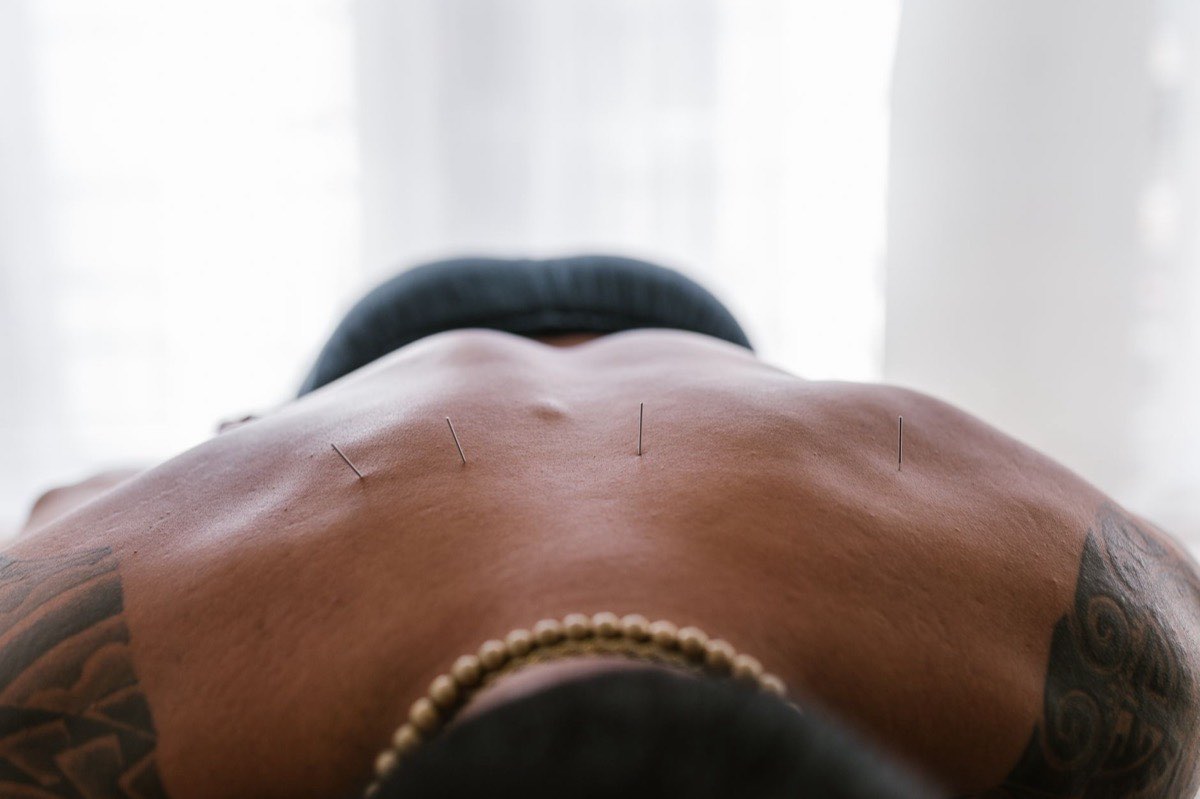
Dry needling uses a thin, sterile, solid filiform needle (no medication, which is why it’s “dry”) placed directly into the trigger point. To be clear up front, this is not acupuncture. It’s a modern, evidence-based, Western-medicine technique grounded in anatomy and the science of how muscle and connective tissue behave.
When the needle reaches the knot, two things happen. You may feel a brief, involuntary local twitch response: a quick, deep cramp-and-release that tells me I’ve found the right spot. And mechanically, the needle does something your hands and a foam roller simply can’t. As the Cleveland Clinic explains:
“Stimulating a trigger point with a needle helps draw normal blood supply back to flush out the area and release tension.”
In plain terms: the needle interrupts the contracted muscle band, draws fresh blood flow into a knot that had been choked off, and lets the muscle reset to its normal resting length. The American Physical Therapy Association, through its patient resource ChoosePT, puts the goal simply, “Dry needling can inactivate trigger points to relieve pain or improve range of motion.” That’s the whole aim: switch off the knot that’s driving your low back pain, so your back can move and load normally again.
And the technique holds up under research. A 2022 randomized, single-blinded study published in the National Library of Medicine compared dry needling plus exercise against a sham treatment in patients with low back pain. The authors concluded that the protocol “can reduce pain and improve functional efficiency in LBP patients,” with benefits still measurable at one- and three-month follow-ups. Dry needling isn’t a magic eraser, but paired with the right movement work, it makes a real, lasting difference.
Why dry needling alone isn’t the whole answer
Here’s something a lot of clinics won’t tell you: a needle releases the knot, but it doesn’t explain why the knot formed. If you only chase the symptom, the trigger point comes right back, same spot, same flare, a few weeks later.
That’s why at Healing Hands, dry needling is never a standalone “needle-and-done” appointment. It’s one tool inside a hands-on plan. After I release the trigger point, I follow up with manual therapy and bodywork (soft-tissue work and joint mobilization to address the surrounding tissue) and then load the muscle correctly so it stays released. We look at why your QL or glute was overworking in the first place: a stiff hip, a weak core, hours of sitting, an old compensation pattern. Treat the cause, and the relief sticks.
What a concierge session actually looks like
If you’ve been to a high-volume PT mill, you know the drill: you’re handed to a tech, parked on a table with a hot pack, and your “needling” is squeezed into a ten-minute slot while the therapist runs three other patients at once. That’s not what happens here.
At Healing Hands, you get Dr. Jamie Pribyl, the same doctor of physical therapy, every visit, for the full hour. Because I treat one person at a time, I can take the time to actually palpate your back, find the specific trigger points driving your pain, needle them precisely, and immediately follow with the hands-on work and movement coaching that makes it last. No rushing, no rotating staff, no being a face in a crowded gym.
This is concierge, cash-pay care, and I see Reno patients across the area, you can learn more about how we serve the community on our Reno services page.
The honest cash-pay value
Let’s talk money, because it’s the question on everyone’s mind. Healing Hands is cash-pay, and I think that’s the better deal for back pain, not in spite of being out-of-network, but because of it.
Insurance-based clinics are paid per visit, which quietly rewards stretching your care across a dozen short, half-attended sessions. With cash-pay concierge care, the incentive flips: I’m paid to get you better, fast. One focused hour with a doctor of PT (real evaluation, precise dry needling, hands-on manual therapy, and a take-home plan) routinely accomplishes what three rushed, copay-plus-coinsurance insurance visits can’t. Fewer visits, no surprise out-of-network bills, no prior authorizations, and a clear price you know going in. For most people, the total cost of getting actually better ends up lower.
Ready to deal with that stubborn knot for good? Call Healing Hands at (775) 452-4471 to book a one-on-one session, and let’s find out what’s really driving your low back pain.
Frequently Asked Questions
Does dry needling hurt? Most people feel a small pinch when the needle goes in, then a brief, deep ache or cramp (the local twitch response) when it reaches the knot. It’s quick and tells us we’ve hit the right spot. Many patients describe a satisfying sense of release, and any soreness afterward usually feels like a light workout and fades within a day or two.
How is dry needling different from acupuncture? They use similar thin needles, but that’s where the resemblance ends. Acupuncture comes from traditional Chinese medicine and works along energy meridians. Dry needling is a modern, Western, evidence-based technique that targets specific muscular trigger points based on anatomy. It’s performed by trained physical therapists, not acupuncturists.
How many sessions will I need for my low back? It depends on how long the pain has been there and what’s causing it, but because each visit is a full hour of focused, one-on-one care, progress is usually faster than at high-volume clinics. Many patients feel meaningful relief within the first few sessions. I’ll give you an honest estimate after your first evaluation, no open-ended packages.
Is dry needling safe? Yes, when performed by a licensed, trained physical therapist using sterile, single-use needles. As a PT, DPT, MTC, I’m trained in the anatomy and technique required to needle safely and effectively.
Can dry needling help if my pain is from sitting all day? Often, yes. Prolonged sitting is one of the most common reasons trigger points form in the low back and glutes. Dry needling releases the knots, and the hands-on and movement work we pair it with addresses the postural and strength factors so they don’t keep coming back.
Sources
- Cleveland Clinic: Dry Needling
- ChoosePT.com (American Physical Therapy Association): Dry Needling by a Physical Therapist: What You Should Know
- APTA: Dry Needling
- National Library of Medicine (PMC): The effectiveness of dry needling in patients with chronic low back pain: a prospective, randomized, single-blinded study